

UPDATED Metrolink Crash in Oxnard/ Engineer in Critical condition

 From The LA TIMES

The train operator (Locomotive Engineer …you morons) severely injured in Tuesday’s Metrolink crash is clinging to life after his heart stopped twice on Wednesday.

A day after the commuter train barreled into a heavy-duty pickup truck in Oxnard and derailed, the engineer was among three still in critical condition at Ventura County Medical Center, said Chief Medical Officer Bryan Wong.

“We’ve been able to keep his heart back now, but it’s certainly unstable and we’re not certain what that’s going to lead to,” Wong said. “It’s touch and go right now in terms of whether he’ll make it.”

Wong said he visited some of the patients who remained at the hospital after Tuesday’s crash.

Officials said 28 people were hospitalized after the pre-dawn crash at 5th Street and Rice Avenue sent three passenger cars tumbling off the tracks and derailed a fourth car and the locomotive. The victims who suffered minor injuries have been gradually released from area hospitals. The most seriously injured were taken to VCMC.

Among those still at the hospital was a regular on the East Ventura Metrolink line, Wong said.  When he asked the woman how she was doing, she only asked about the train’s engineer.

“It was very heartwarming,” Wong said. “It really reflects upon what type of man … [he] was and the lives that he touched.”

The engineer went into cardiac arrest, his heart stopping, at 10 a.m. and then a second time after medical personnel restarted it, Wong said.

Meanwhile, the investigation into what caused the crash and the train’s derailment continues. The National Transportation Safety Board is reviewing the train’s data recorder and footage from its cameras and investigating how and why the truck ended up on the tracks.

Oxnard police arrested the truck’s driver, Jose Alejandro Sanchez-Ramirez, 54, for allegedly abandoning his truck on the tracks after it got stuck. His attorney, Ron Bamieh, said Sanchez-Ramirez accidentally turned onto the tracks when he thought he was turning onto a street and couldn’t drive the truck off the tracks once it was on them. His client left the truck to find help and tried to warn the train by flashing the truck’s high beams before the crash, Bamieh said.

Sanchez-Ramirez was found more than a mile away from the site and was arrested on suspicion of felony hit and run. He’s scheduled to be arraigned Thursday afternoon.

Service on the line was shut down for the remainder of Tuesday but was restored by Wednesday afternoon.

For the latest on the Metrolink crash, follow

 http://abcnews.go.com/US/wireStory/metrolink-train-strikes-truck-southern-california-29182855

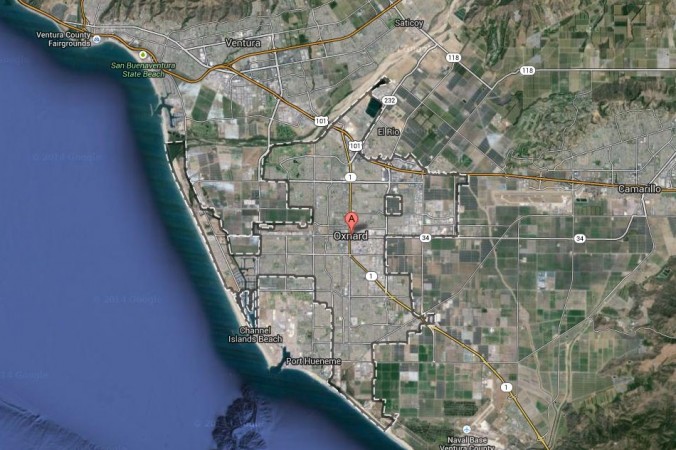
(ACCIDENT WAS AT THE CROSSING AT 5TH AND RICE JUST OUTSIDE OF THE STATION)

At least three Metrolink train cars derailed after the train hit a vehicle on Tuesday morning, according to NBC.

The train was going from Oxnard and Camarillo.

Per NBC:

The vehicle was on the Ventura County Line tracks at the time of the collision, just before 6 a.m., according to Metrolink. Several cars were on their sides near 5th Street and Rice Avenue and the vehicle, described as a utility truck, was on fire after the crash about 80 miles northwest of Los Angeles.

According to AP:

Three cars of a Southern California Metrolink commuter train have derailed and tumbled onto their sides after a collision with a truck on tracks in Ventura County northwest of Los Angeles.

Oxnard police Sgt. Denise Shadinger says the crash reported at 5:44 a.m. Tuesday caused a number of injuries.

Shadinger says the truck became fully engulfed in flames.

A KABC-TV news helicopter was showing firefighters treating numerous people at the scene.

Metrolink’s website says the train was on a run from Ventura County to Los Angeles.

Says CNN:

The train hit a vehicle just before 5:45 a.m., the California Highway Patrol said online. Several cars derailed, and at least one vehicle was said to be “fully engulfed,” the patrol said.

Aerial television crews are filming a scene of devastation. First responders are pushing injured people in stretchers. Some people are lying on the ground, and firefighters have hoses on cars that are off the track. Emergency vehicles dot a long stretch of road.

oxnard-1-676x450

532185_1280x720 532268_1280x720 532229_1280x720 532209_1280x720

The case for higher wages: It’s smart business

From LA TIMES


Aetna Chief Executive Mark Bertolini announced last month that the insurance giant would hike wages for low-level employees to at least $16 an hour and eventually lower healthcare costs for some workers. The reason? In part, Bertolini wants to cut into the $120 million the company spends each year hiring and training new workers to replace those who quit.

But more important, he said, it is the right thing to do. “Companies are not just money-making machines,” Bertolini told the New Yorker’s James Surowiecki. “For the good of the social order, these are the kinds of investments we should be willing to make.”


Bertolini is right (even if his firm has madesome other missteps). Globalism, the casualization of labor (replacing full-time employees with contractors and part-timers) and a zealous fixation on profits above all else have left the American middle class in shambles. That’s a dangerous thing for a consumer economy.

And ultimately it’s not particularly good for a business to pay its workers the lowest possible wage. A substantial amount of research shows that a well-paid workforce is a happier and more productive workforce, with long-range benefits for the business. Of course, that’s contrary to the short-horizon investment pressure from Wall Street and the crass greed in executive suites, where most of the nation’s economic gains of the last five years have wound up.

Bertolini’s stance puts him in company with the leadership at Costco, Trader Joe’s, the Container Store and even tiny Moo Cluck Moo, a Michigan fast-food joint that pays its workers $15 an hour. It is, as my colleague Jon Healey pointed out in an email, “enlightened self-interest.”

But it’s also an acknowledgement that the current economic system has wobbled out of balance under greed’s massive gravitational force. As Moo Cluck Moo co-founder Brian Parker told Crain’s Detroit, “I’m taking less money personally. … My question is, how much do we have to make? How big of a pile of money do CEOs have to sit on? … I’m not altruistic, but I’m also not trying to extract as much money as possible out of the restaurant.”

That’s the crucial bit: An approach to business that focuses not on wringing every last penny of profit from the enterprise but on sustaining the business and treating workers as part of the effort, not as just another cost center.

Two bits of history come to mind. In early 1914, Henry Ford ticked off his fellow automakers and Wall Street investors when he offered to pay workers $5 a day, double the going rate. He hoped it would stabilize his workforce (the assembly line was drudgery with high turnover and absenteeism) and also help build a consumer culture for the mass-produced cars he was trying to sell. He achieved both.

The second bit of history: As Ford was doubling his line workers’ wages, out in Colorado coal miners were on strike for union recognition, and improved wages and working conditions (during that months-long strike, at least 75 people were killed, including 11 children and two mothers in the April 20, 1914,Ludlow Massacre). Mine owners, including the Rockefellers, had a distinctly different view of their workers than did Ford. Miners, who were paid based on how much coal they dug, were seen as expendable. If one died in a rock fall, another could easily replace him with no additional cost to the company. But if a mule died, the owner would have to buy another one. Thus mules were considered more valuable to the mine than the men who did the dangerous work.

As the modern economy steers more and more to a casual link between job sites and workers – that shift from employee to “contractor” – it’s heartening to see that some folks in the executive suites understand the greater cost to society, and to the economic health of our communities, in the endless quest for more profits.

Let’s hope Bertolini’s outlook is contagious.

West Coast Ports Could Shut Down in Days


Brothers,

The PMA clearly acts just like UP fear and intimidation at its finest…..some information for your reading pleasure


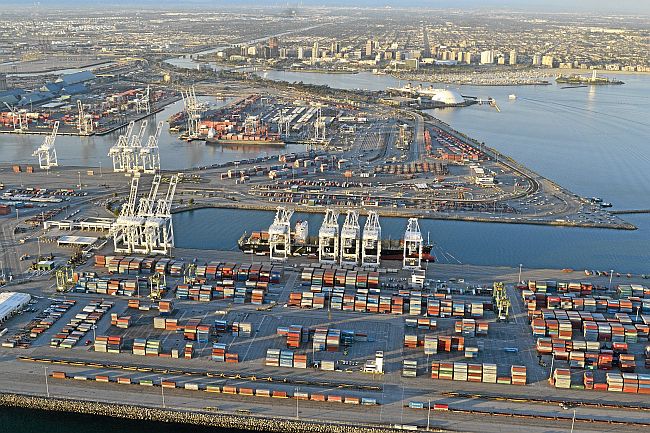
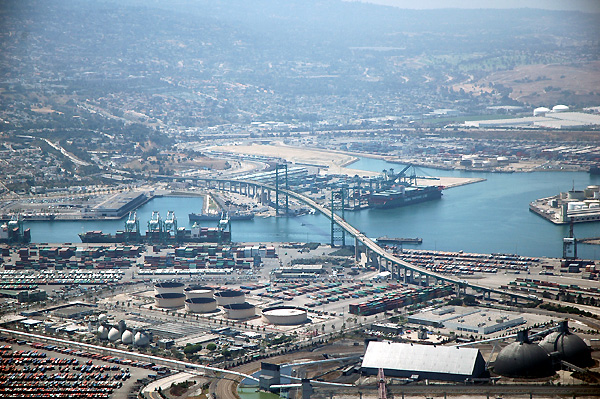
Long Beach, Calif. Aerial

West Coast Ports Could Shut Down in Days


Traffic at nearly 30 West Coast ports is on the verge of “complete gridlock” and shipping officials have threatened to stop paying dockworkers if a contract deal is not reached soon.

Speaking at a press conference on Wednesday, Pacific Maritime Association CEO James McKenna said West Coast seaports, which handle some $1 trillion in trade per year, could shut down in the next five to 10 days and cripple U.S. trade with Asia. He said the organization is not considering a technical “lockout,” but warned that the shipping system would inevitably bring itself to a stop if congestion persists.

PMA and the International Longshore & Warehouse Union have been working to negotiate new contracts since May. Nearly 20,000 dockworkers at 29 ports are impacted. PMA says ILWU has conducted slowdowns, walk-offs and other actions at key ports, aggravating congested conditions and disrupting cargo movement in a bid to influence the talks. He said productivity had dropped between 30 percent and 50 percent in recent months, crippling whole strings of vessels, in some cases. It’s like “they’re getting paid to grind us into the ground,” McKenna said.

The union denied the claims and said the congestion crisis was “employer-caused.”

http://www.nbcnews.com/business/economy/west-coast-ports-could-shut-down-days-cripple-asia-trade-n300701

gyb_vtb

from Puget sound

West Coast ports could shut down in next 5 days


Take the contract, or the imminent shutdown is on you.

That was the message from Pacific Maritime Association President James McKenna Wednesday afternoon.

The PMA offered the International Longshore and Warehouse Union a labor contract Tuesday. McKenna called it the best offer the PMA could come up with.

In the offer, longshore workers receive an annual income of $147,000 with the option of a 3-to-5 percent increase per year and a fully paid health care plan known as a “Cadillac plan.” The Affordable Care Act mandates that the PMA pay a premium on that plan: $35,000 per year, per worker.

The contract would be valid for five years.

The offer includes all the bells and whistles, McKenna said. If the union doesn’t agree to it, he said the ports could shut down in as few as five-to-10 days. He said that the PMA doesn’t want a lockout, but may not have any other choice.

Negotiations are at a point where anything was possible, he said, and that’s why the PMA pulled out all the stops in this contract.

“The PMA must decide how much longer we will pay longshore workers to work slowly,” McKenna said. “It’s the same result as a strike, but they are still getting a paycheck.”

McKenna said he was confident that the two parties could reach an agreement.

The ILWU agreed that they were close to signing a contract.

“We’ve dropped almost all of our remaining issues to help get this settled – and the few issues that remain can be easily resolved,” said ILWU President Robert McEllrath.

The ILWU has also offered up a contract in the past, but the PMA did not agree to it.

There are about six major issues outstanding including: wages, pensions, terminal contracts, the arbitration process, how to decide disputes that happen on the docks and how exactly ports operate, McKenna said.

The PMA and ILWU are far apart on about half of them. He didn’t specify which issues they were far apart on.

The PMA and ILWU have been renegotiating an expired labor contract since May 15. The six-year contract ended on July 1.

But beginning on Oct. 31, the PMA accused the ILWU of intentionally slowing down work at the ports to influence talking power. The ILWU denies these claims and says the slowdowns are because of major changes in the industry that make their job more difficult.

Regardless, the slow negotiations have rippled throughout ports all along the West Coast,including the ports of Seattle and Tacoma. In a state where 40 percent of jobs are linked to trade, that’s a big deal. Agricultural products have sat rotting at the docks – the apple industry alone estimated losing about $19 million a week. Import and export businesses have been working at 25 percent normal capacity and are months behind their contracts.Companies have laid off staff because of the lack of work. Traders in China have raised their concern to Port of Seattle staff. Retail importers have had to fly in their products at a high mark-up price.

“Closing the ports at this point would be reckless and irresponsible,” McEllrath said.

McKenna estimated that West Coast ports were operating an average of 50 percent slower than normal. Nearly 50 ships are anchored at West Coast ports waiting to be unloaded, he said.

“In the very near future, every ship servicing trade will be literally parked on the West Coast of the United States,” he said.

At the beginning of January, both parties requested help resolving negotiation hurdles from a federal mediator after pressure from trade associations, businesses and lawmakers.

The mediator has had a positive impact on negotiations, McKenna said, but he can’t force the two sides to come to agreement on certain issues.

Since the involvement of a mediator, the two parties have determined who will repair and maintain chassis but not the details of how exactly that will happen.

Until now, both the PMA and ILWU have been tight-lipped on the details of negotiations. McKenna’s statements offered a first comprehensive look at what has been stalling negotiations, and ports, for months now.

The offer from the PMA is comprehensive, but it isn’t final.

“We put it all on the table,” McKenna said. “Would I ever say that nothing will change on that agreement? No.”

slide_266593_1823282_free.sm_


ILWU President blasts PMA threat to shut down US ports

Photos of empty docks show that PMA employers, based largely overseas, are worsening a congestion crisis at West Coast ports to pressure American workers
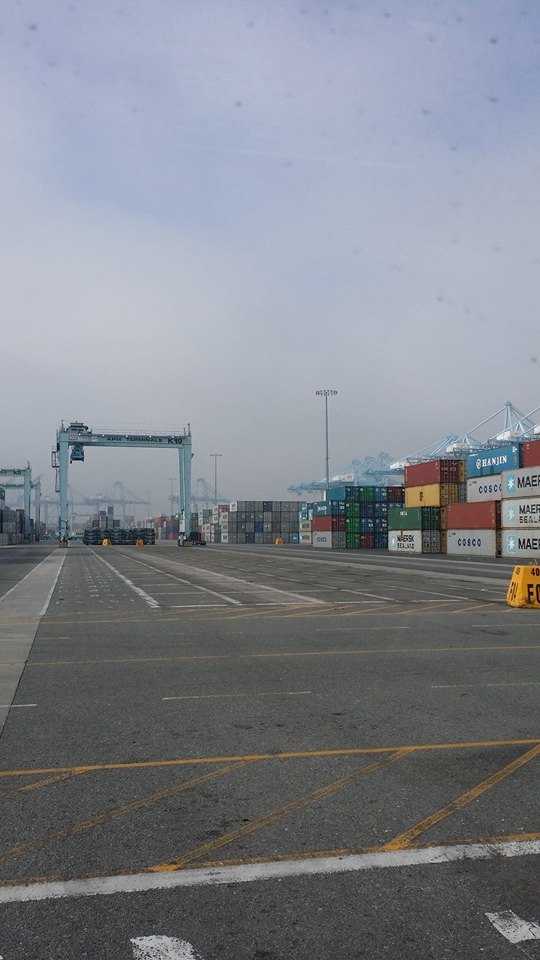
Southern California ports have acres of asphalt waiting for containers

SAN FRANCISCO, CA (February 5, 2015) – ILWU International President RobertMcEllrath today blasted the Pacific Maritime Association for threatening to shut down West Coast ports, bargaining in the media, and distorting the facts. “What the ILWU heard yesterday is a man who makes about one million dollars a year telling the working class that we have more than our share,” saidMcEllrath. “Intensifying the rhetoric at this stage of bargaining, when we are just a few issues from reaching an agreement, is totally unnecessary and counterproductive.”In mid-January, PMA claimed that there was a lack of dock space for containers, and it eliminated nightshifts at many ports. Today, the union provided photos disputing the employer group’s assertion that docks are too congested to unload ships.

“PMA is leaving ships at sea and claiming there’s no space on the docks, but there are acres of asphalt just waiting for the containers on those ships, and hundreds of longshore workers ready to unload them,” said McEllrath. “The employers are deliberately worsening the existing congestion crisis to gain the upper hand at the bargaining table.”

The union provided several photos of marine terminals in Southern California that show large tracts of space that would easily fit thousands of containers.

“The employers’ threat to shut down West Coast ports is a reckless and unnecessary move,” said McEllrath. “What the employers need to do is stay at the negotiating table and work through a few remaining issues with the workers who have made them successful for the past 80 years. We are very close to reaching an agreement.”

The PMA is an employer association whose largest members include Denmark-based Maersk Line, Taiwan-based Evergreen Marine, Korean-based Hanjin Shipping, Philippines-based ICTSI, Japan-based NYK Line, Hong Kong-based OOCL, China-based COSCO, and other employers based in France, Norway and worldwide.

The International Longshore and Warehouse Union is based in San Francisco, Calif., and is negotiating a contract that has covered longshore workers at 30 West Coast ports in California, Oregon and Washington since 1934.

– ILWU news release


Longshore workers’ union chief slams employers for West Coast shutdown threat


The head of the longshore workers’ union on Thursday slammed a maritime association for portending a shutdown of West Coast ports, calling it “a reckless and unnecessary move.”

Robert McEllrath, president of the International Longshore and Warehouse Union, especially criticized Pacific Maritime Association CEO Jim McKenna for what he called using bargaining tactics with the media and warping the facts of an imminent closure of ports along the West Coast, including the ports of Los Angeles and Long Beach, the nation’s largest seaport complex handling 40 percent of U.S. imports.

McKenna, whose association represents employers at 29 West Coast ports, on Wednesday spelled out the possibility of an impending shutdown after the PMA’s “best offer” was presented to the ILWU, including 3 percent raises each year and the full payment of employee health care costs.

“What the ILWU heard yesterday is a man who makes about $1 million a year telling the working class that we have more than our share,” McEllrath said in a statement Thursday. “Intensifying the rhetoric at this stage of bargaining, when we are just a few issues from reaching an agreement, is totally unnecessary and counterproductive.”

McEllrath said that both sides are “very close” to an agreement.

“The employers’ threat to shut down West Coast ports is a reckless and unnecessary move,” he said. “What the employers need to do is stay at the negotiating table and work through a few remaining issues with the workers who have made them successful for the past 80 years.”

In its released statement, the ILWU also attached photos of wide open spaces to contradict PMA’s decision to suspend night shifts for unloading ships, which the employers group said had to be done due to lack of space in clogged terminal yards.

“PMA is leaving ships at sea and claiming there’s no space on the docks, but there are acres of asphalt just waiting for the containers on those ships, and hundreds of longshore workers ready to unload them,” said McEllrath. “The employers are deliberately worsening the existing congestion crisis to gain the upper hand at the bargaining table.”

PMA officials, who could not be reached for comment Thursday, have denied that the move was punitive.

In the meantime, the mayors of Long Beach and Los Angeles issued a joint statement Thursday calling for an agreement to avoid the potentially catastrophic economic repercussions of a shutdown.

The local ports “are important engines for our local and national economy, so it is critical that both the ILWU and PMA continue talking to quickly reach an agreement and return our ports to efficient operations,” Long Beach Mayor Robert Garcia and Los Angeles Mayor Eric Garcetti said in the statement.

Last month, a federal mediator stepped in to intervene in talks at the request of both sides. Dockworkers have been without a contract since July.

The unresolved talks have worsened bottlenecks at the ports, which are struggling to handle the congestion created by the arrival of bigger ships carrying more cargo, the uneven distribution of chassisand a shortage of rail cars.

This has resulted in ships stranded at sea, long truck lines at terminals and weekslong shipment delays, forcing customers to ship goods by air or divert them to other ports. The Marine Exchange of Southern California reported Thursday that 18 ships sat in the water at the ports of Los Angeles and Long Beach because of congestion.