Open enrollment begins November 1, 2014 for the BLET Short Term Disability Plan

From BLET.org

Open enrollment begins November 1, 2014 for the BLET Short Term Disability Plan – Important Changes and Enhancements to Plan B CoverageCLEVELAND, October 9 — Open Enrollment for 2015 under the BLET’s Short Term Disability insurance plan begins on November 1, 2014 and runs through December 15, 2014.

If you are a locomotive engineer working on a railroad that participated in the Wage/Rules portion of the National Agreement dated December 16, 2003 (as an example; BNSF, NS and Amtrak did not participate in this Plan so this information does not apply to engineers working on these properties), your coverage under Part A (described below) of the BLET Short Term Disability Plan will automatically continue.

If you currently do not participate in Part B coverage (also described below), you may elect coverage during this enrollment period. If you currently participate and wish to opt out of Part B coverage, then you can also do so during this enrollment period.

Part A — NON-OCCUPATIONAL DISABILITIES

There will be no changes to Part A coverage:

• Your eligibility and $40 premium is submitted by the railroad on a monthly basis.
• Part A pays $402 per week for non-occupational disabilities only, up to 52 weeks’ coverage.
• Occupational disabilities are not covered.
• Each eligible member is insured for $50,000 of Accidental Death and Dismemberment (AD&D) coverage.
• There is a 14-day waiting period.

Part B — OCCUPATIONAL DISABILITIES

The premium cost for Part B coverage was reduced significantly to $18 per month in 2014. In addition, if you currently participate in Part B coverage or are currently eligible for Part A and enroll in Part B coverage, Part B will now also cover non-occupational disabilities in the case that you are demoted to train service and become ineligible for Part A coverage.

Part B is voluntary. Participation in this additional occupational coverage is not required.

• The weekly benefit for occupational disabilities is $402 per week, up to 52 weeks.
• Each eligible member is insured for an additional $50,000 of AD&D coverage. When participating in both Part A and Part B there is a total of $100,000 of AD&D coverage.
• The benefit is not subject to repayment upon receipt of a FELA settlement (no repayment after a personal injury settlement).
• The benefit is not considered taxable income.
• The Part B premium will be paid either via a payroll deduction or via an automatic monthly direct withdrawal authorization arranged with your banking/financial institution.
• There is a 14-day waiting period.

NOTE: SMART-TD members working as engineers are eligible for Part A and may purchase Part B coverage by making an annual payment of $216 to the BLET Short Term Disability Trust Fund. (Complete the form at the link below and return to address noted by December 15, 2014.)

FILING A CLAIM FOR BLET SHORT TERM DISABILITY

• Call 1-800-858-6506 – MetLife Claim Center.
• Tell them you would like to file a claim under BLET Short Term Disability.
• Provide information requested, including contact information for your attending physician(s).
• A Case Manager will be assigned and you will receive a file number, which you must keep available for future reference.
• Following the call, you will receive an authorization for release of medical information.
• Sign the document and return to MetLife.

IMPORTANT:
Your initial eligibility for Part B remains dependent upon your eligibility for Part A. In order to be eligible for Part A, you must have seven (7) starts in a month (with at least one (1) start as an engineer) prior to enrolling for coverage.

If you are enrolled in Part B and are demoted to train service and become ineligible for Part A coverage you will no longer have to notify the Secretary-Treasurer of your local division. Your Part B coverage will automatically cover you for both occupational and non-occupational disabilities until you (1) again become eligible for Part A, (2) elect to discontinue your payroll deduction for Part B coverage, or (3) are no longer a locomotive engineer working on a railroad that participated in the Wage/Rules portion of the National Agreement dated December 16, 2003.

CHOICES THAT MUST BE MADE BY DECEMBER 15, 2014

If you currently do NOT participate in Part B and choose to do nothing, you will continue to be eligible for Part A coverage only. If you are currently enrolled in Part B and wish to remain enrolled, then you are not required to take any action.

If you currently do NOT participate and would like to sign-up for Part B coverage during this open enrollment period, or if you DO currently participate and would like to opt-out of Part B coverage, you must complete and return the attached form (link below), by December 15, 2014, to the Secretary-Treasurer of your local division. Your election will become effective on January 1, 2015.

Members, who OPT-OUT of Part B coverage effective January 1, 2015, will not be eligible to enroll for the coverage until the next annual enrollment period. No exceptions will be made.

DESIGNATION OF BENEFICIARY(IES)

You are able to designate your beneficiary(ies) for the AD&D coverage on-line. If you would prefer to submit a paper beneficiary form, one is available on MetLife’s website. A simple registration process is required the first time you access www.metlife.com/mybenefits. Designating your beneficiary(ies) will ensure that your benefit proceeds are paid according to your wishes. If you do not have a designation of beneficiary(ies) on file, proceeds will be paid according to the AD&D plan’s facility of payment clause. Beneficiary designation for this coverage will not impact beneficiary designations for any other Life Insurance or AD&D plans that you may have with MetLife.

QUESTIONS

Anyone with questions regarding BLET Short Term Disability should contact Megan Mead, BLET Short Term Disability Liaison, at 216-241-2630 (ext. 205) or email at mead@ble-t.org.

A copy of the opt-in/opt-out form is available here on the National Division website.

A copy of the annual enrollment form for SMART-TD members can be found here.

Dolores to Yuma Pool jp016 re31 important

Brothers

Cms has notified me they are adding the ZCIBP to the long pool TONIGHT. I will be adding to the re31 as well as the JP016 xe10

If your interested please put your application or standing bid in the CMTS system. I was also informed they will be adding more

trains next week out of Los Angeles. also make sure you are claiming your initial and final terminal delay. even if you post 86

you are entitled ITD and FTD until a trip rate is established. we must put the time in to make sure we are getting what we are

owed on this trip rate.that includes any r/a off assignment etc..

20140827_124414

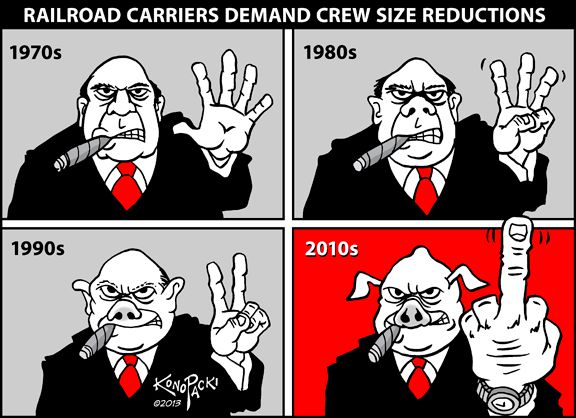
Protecting two-person crews is still our goal


2013 Cartoon Single Crew Graphic alone

(The following is a statement by Dennis R. Pierce, National President of the Brotherhood of Locomotive Engineers and Trainmen (BLET), regarding recent media reports concerning a tentative contract agreement that would open the door to single-person train operations along portions of the BNSF Railway.)

CLEVELAND, July 21 — The BLET National Division has received many requests for comments following the announcement last week that BNSF and one of the SMART Transportation Division General Committees of Adjustment (STD GCA) representing trainmen on BNSF have negotiated a new Crew Consist Agreement that allows for engineer-only operations under certain circumstances. As we understand SMART’s internal rules, their General Committees of Adjustment are not unlike BLET’s in that they have the autonomous authority to negotiate and interpret contracts. That said, and from the statement issued by SMART Transportation Division President Previsich on July 18, the single STD GCA that entered into the new Crew Consist Agreement does not speak for the SMART Transportation Division. Correspondence is also in circulation that would indicate that this single STD GCA does not speak for any of the other STD GCAs on BNSF.

Almost one year ago to the day, I issued a statement following the disaster involving a one-person crew in Canada urging BLET’s membership, and the officers and membership of SMART’s Transportation Division, to join us in an effort to ensure safety on the nation’s rails by supporting two-person crews. I was clear then that there are three avenues available to protect a two-person crew: regulation, legislation, and collectively bargained agreements. BLET has no intention of discontinuing our efforts on the regulatory or legislative fronts. We will continue our effort to advance H.R. 3040 in the U.S. House of Representatives as well as similar legislation on the state level, and are awaiting FRA’s regulation on crew size with every intention of commenting in support of a two-person crew for all over the road train operations.

And on properties like the Wheeling and Lake Erie (WLE), where BLET is the designated bargaining agent for both engineers and conductors, BLET stands steadfastly at the bargaining table, refusing to give up the conductor’s position as WLE insists we do. In fact, I authorized a strike against the WLE in late 2013 over their refusal to call conductors when they were available. Our members on the WLE have made it clear through their solidarity that they will not accept an agreement that would eliminate the conductor’s position, and they have the full support of the BLET National Division in this fight.

Things are vastly different in the Class I railroad world, where BLET represents the majority of the nation’s engineers and SMART represents the majority of the conductors. To preserve a two-person crew through collective bargaining, each union must protect the craft and class that it is authorized to bargain for. In 2007, BLET and BNSF negotiated such an agreement, revising the scope of duties belonging to locomotive engineers and, in doing so, preserved the work rights of BNSF engineers well into the future. Similar agreements were negotiated on Norfolk Southern and CSXT in that bargaining round. The reasoning behind these agreements is straightforward: neither BLET nor SMART can protect a two-person crew if each union does not collectively bargain agreements that preserve the work rights of the craft for whom it is the bargaining agent.

While BLET’s 2007 agreements recognized that the involved railroads did not have to bargain further with BLET should engineer-only operations ever come to pass, that recognition was hardly necessary as it was merely recognition of the status quo. BLET General Committees of Adjustment, and the BLET at large, were not and are not the NMB designated bargaining agent for trainmen or conductors on the involved railroad properties, and as such, have no jurisdictional authority to bargain on their behalf. Instead, that authority is vested in SMART’s Transportation Division, formerly UTU, and only SMART has the jurisdictional authority to bargain for and protect those positions. In fact, when the 2007 BLET/BNSF Scope Agreement was negotiated, engineers had already been required to work engineer-only helper assignments on BNSF following UTU’s failed effort to preserve their ground crew position on those assignments. Purely as a result of SMART being the designated bargaining agent for trainmen and conductors, BLET’s agreements with BNSF have never included crew consist requirements that govern the number of ground crew members required or that prevent engineers from being required to work engineer only, nor can they.

BLET’s 2007 Agreement with BNSF was overwhelmingly ratified by a membership vote, a vote to preserve those members’ jobs, and it is my understanding that the BLET General Chairmen responsible for enforcing that agreement are reviewing the BNSF/STD proposal to determine whether any portion of it conflicts with BLET’s 2007 Agreement. At the same time, SMART’s membership on a portion of BNSF is now in the same position as BLET’s membership was in back in 2007; they must decide if the proposal they have been provided actually preserves jobs or eliminates them, and determine if the balance between those two outcomes warrants ratification or rejection.

In either event, BLET’s National Division remains as committed to working to preserve two-person crews as it was a year ago when I commented following the Canadian disaster. We will continue to work with the National Representatives of SMART’s Transportation Division wherever and whenever in an effort to preserve and protect two-person crews. That includes the regulatory front, the legislative front, and on the collective bargaining front where possible. The stakes are too high to do otherwise; the safest and securest workplace for the nation’s railroads, their employees and the public at large is one that includes a minimum of a two-person crew.

Tiger Lyons

By Michel Nolan, The Sun


As a railroad man, on the job nearly 60 years, Tiger has proven he has nerves of steel and a will of iron.

The railroad is in his DNA.

How hard it must be then to walk away from a job that is a way of life.

Tonight will be Tiger’s final ride on a Union Pacific freight train as it thunders along the tracks from Colton to Orange County and beyond.

Tiger Lyons is retiring.

I couldn’t wait to talk with this man who has started his night shift like clockwork at the Colton railroad yard for nearly six decades.


Tiger is a quiet man, soft-spoken and kind.

He told me he wanted to keep his retirement “low profile.”

And it will be — but a few more people will know of a job well done by this man who has dedicated his life to the railroad.

The railroads put this country together, he’ll tell you. He’s glad to be part of the railroad experience.

Kenny Naucler, Tiger’s supervisor, has known him 35 years.

“All his years of service just show his work ethic,” Kenny said. “It would be amazing in any industry to have this length of service. He’s a genuine nice guy, one-of-a-kind.”


Tiger does his job right and helps new hires learn the job right, Kenny added.

Now 77, this father of three sons doesn’t mind the nightly drive from his Victorville home to the huge Union Pacific rail yard in Colton, where he works all night.

Over the years he has seen the transition from steam to diesel, the crackdown on safety rules and regulations, and more efficiency in communications.

“In 1955, there weren’t as many safety rules — it was different — you just did what they told you to do,” Tiger said.


He remembers when it was common practice to walk over the tops of cars while the train was moving — like a movie stuntman.

“It only sounds amazing if you’re not familiar with it. We don’t do it anymore,” he said, downplaying the danger.

In 1955, as a teenager living in Glendale, Tiger started working for the railroad as a brakeman out of the Los Angeles yard. Soon, he tested for the conductor position, a job he has enjoyed ever since.

And no, a conductor does not walk up and down the aisle on a freight train collecting tickets.


Conductors are like managers, deciding where to put the cars — where to put the lumber car, the hazardous materials car.

On a recent route from Colton through Anaheim, La Mirada and Santa Fe Springs, the train was one mile long and included 86 cars for a total of 10,000 tons snaking along the tracks.

He considers a 30-car train short and says, “When we get one of those, we can run like a rabbit.”

From his original base in Los Angeles and then Colton, Tiger’s routes have taken him to Yuma, Ariz., and Bakersfield, Santa Barbara and El Centro.


About his 20 years of runs between Colton and Yuma, Tiger says, “The same lizard has been sitting on the same rock every time we go to Yuma.”

Tiger also noted that after 20 years, he has never seen a flying saucer out there in the desert where there are so many sightings.

In the old days, crews were composed of a conductor, an engineer, a fireman and three brakemen.

Nowadays, thanks to technology, engineer-and-conductor two-man crews handle the workload.

A workload Tiger can still handle.

I could work another year or two,” he says, “but I thought I’d just step aside.”


What’s next for this rugged railroad man?

Surprisingly, he likes the idea of travel and is thinking about taking a train (Amtrak) up to see his brother in Eugene, Ore., and maybe do some sightseeing in Canada as well.

He’ll be able to spend more time with his three sons — Bill Jr., who drives a cement mixer; Richard, a San Bernardino County firefighter/engineer; and James, a fireman/paramedic for the Apple Valley Fire Protection District.

“I love them all, and they’re all handy up here in the High Desert,” the senior Lyons said.


And how much will he miss the steel rails and thunder along the tracks?

“You can’t do this all your life and not miss it,” he said simply.


And here’s a thought for the day: Take my advice, I’m not using it.