Author: LCDIV5
Union Meeting tomorrow
Brothers,
Please try and attend our regular monthly meeting for March. Tomorrow Tuesday March 15 2016 @1030.

Teamsters joint council 42
981 corporate center drive
Suite 200 Pomona Ca

Federal Railroad Administration’s Highest-Ever Penalty Collection Rate
U.S Department of Transportation
Office of Public Affairs
1200 New Jersey Avenue, SE
Washington, DC 20590
www.transportation.gov/briefingroom
Wednesday,January 20, 2016
FRA Public Affairs
frapa@dot.gov
Stepped-Up Enforcement Leads to
Federal Railroad Administration’s
Highest-Ever Penalty Collection Rate
Enforcement push is part of broader effort to
increase overall rail safety
WASHINGTON—The Federal Railroad Administration (FRA) today announced that its stepped-up enforcement of railroad safety regulations led to the highest-ever civil penalty collection rate in the agency’s 50-year history.
For Fiscal Year (FY) 2015, the agency will collect 75 percent of all civil penalties it issued to railroads for violating federal safety regulations – a six percent increase over FY2014, and the largest percentage rate ever collected by the agency. The total amount of civil penalties in FY2015, $15 million, increased by 12 percent compared to the previous year.
“Safety must be the number one priority for every railroad, and the Department of Transportation will continue to take aggressive action against railroads who fail to follow safety rules,” said U.S Transportation Secretary Anthony Foxx. “A strong safety enforcement program is critical to prevent accidents, save lives and move our country forward.”
FRA’s collection rate is the highest in the agency’s history and significantly higher than previous years.

Last year, more than 6,485 railroad company violations resulted in civil penalties. The largest portion of those violations, 29 percent, was for motive power and equipment violations, followed by 26 percent for track violations.

“Setting a record for collections is an important milestone, but it is just one element of FRA’s broader effort to achieve a safer rail system,” said FRA Administrator Sarah E. Feinberg. “As we continue to aggressively enforce safety regulations, FRA will also continue to implement new, innovative solutions to increase safety.”
The stepped-up enforcement of safety regulations is part of the Federal Railroad Administration’s larger, comprehensive effort to increase safety of the nation’s rail system. Administrator Feinberg has also prioritized railroad crossing safety, improving the safety of hazmat and crude transport, increasing transparency and working more closely with the National Transportation Safety Board (NTSB).
To read the full report, visit: https://www.fra.dot.gov/eLib/details/L17311#p1_z5_gD.”
_______________
With respect to many of these violations, the FRA would not have known about them but for input from working railroaders. While the FRA has inspectors, there are not nearly enough of them to identify most violations. Reports of potential violations and unsafe conditions to local union legislative representatives lead to FRA investigations with the results you see here. This is particularly true of the motive power and equipment (MP&E) category because train and engine service employees are the first to notice the unsafe conditions. In many instances, if you write up an unsafe condition report, your local union legislative representative will pass this on to state legislative officers. They usually follow-up the local reports with reports to the FRA. Admittedly, the FRA will not investigate every unsafe condition reported to it, but if it sees a pattern of railroad violations and unsafe conditions, it is more likely to send out an investigator.
The bottom line here is to let your local union officers know about the violation or unsafe condition so that it can be followed-up in writing and memorialized for future reference. I know that many of you have heard this before at union meetings, but it cannot be stressed too often – report unsafe conditions and defective equipment and report them promptly. All of the categories listed in the U.S. Deparment of Transportations’ news release above are important, but the ones most likely to be observed by railroad employees are the operating practice (OP) and the motive power and equipment (MP&E) violations.
Union Pacific workers file class action Americans With Disabilities Act complaint against railroad
SEATTLE, Wash. — On February 19, 2016, six current and former employees of Union Pacific Railroad Company filed a class action lawsuit in the Western District of Washington at Seattle (Case No. CV15-1865JCC), asserting that Union Pacific engaged in a pattern and practice of discrimination in violation of the Americans with Disabilities Act (“ADA”), 42 U.S.C 12101 et seq.
The case alleges that Union Pacific has put numerous long-time employees out of work due to their actual or perceived disabilities even though they could perform their jobs. The suit explains that Union Pacific requires certain employees to disclose particular health events or conditions. Once an employee makes such a disclosure, Union Pacific removes the employee from service and conducts a so-called “Fitness-for-Duty” procedure, but the employees allege that this evaluation does not assess whether an employee can perform the essential functions of their job. The employee is not even physically evaluated, and Union Pacific routinely disregards the opinions of treating doctors who do evaluate the employee. Instead, Union Pacific collects extensive medical information from the employee and conducts a “file review” of the information. Plaintiffs allege that Union Pacific then mines the medical information and disqualifies the employees from service–either by deeming them “medically disqualified” or by issuing permanent, unnecessary work restrictions that it then refuses to accommodate.
The six named plaintiffs allege that Union Pacific discriminated against them through this “Fitness-for-Duty” protocol. The plaintiffs include the following employees, all of whom were taken out of service by Union Pacific:
– An individual who has had a pacemaker for more than 20 years as a Union Pacific employee, who had never had a work-related incident as a result;
– An individual with fully-controlled epilepsy who had never had a work-related incident as a result;
– An individual who had lightheadedness on a few isolated incidents outside of work;
– An individual with a fully-controlled heart condition who never had a work-related incident;
– An individual with fully-controlled seizure disorder; and
– An Iraq War veteran formerly diagnosed with PTSD who never had a work incident as a result.
Plaintiffs seek to certify a class of: “Individuals who were removed from service over their objection, and/or suffered another adverse employment action, during their employment with Union Pacific for reasons related to a Fitness-for-Duty evaluation at any time from 300 days before the earliest date that a named Plaintiff filed an administrative charge of discrimination to the resolution of this action.”
Tuesday, March 01, 2016
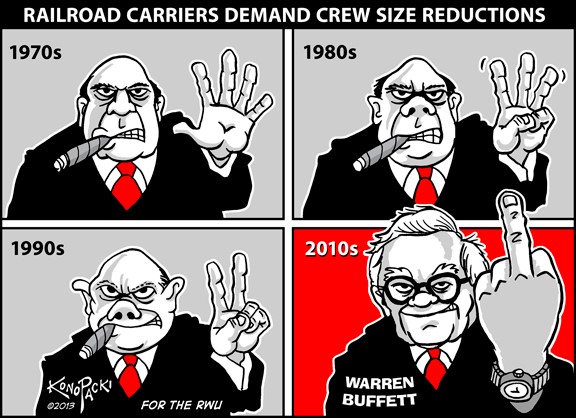
UP stand on one man crews
from http://www.up.com/media/train-crew/index.htm
Union Pacific Statement Regarding Train Crew Size
Union Pacific is not seeking to implement single-person crews at this time, but is opposed to legislation that would require two-person crews.
-
State legislation that attempts to alter terms of collective bargaining agreements would threaten the integrity of ratified local labor agreements and compromise future cooperation and negotiations on this issue.
-
Individual state laws mandating crew size will interfere with the ability of railroads and unions to fully bargain the best and safest crew size for each assignment. It would hinder investment and implementation of safe, cost-saving technology. This will put industries and shippers in those states at a competitive disadvantage with respect to other states that do not have these artificial restrictions. Interstate commerce also would be affected, due to operational challenges associated with differing state crew-size requirements.
-
Commuter agencies throughout the nation, including Amtrak, operate thousands of passenger trains daily with one person in the cab. The safety record for this practice is excellent and dates back to the early 1970s.
-
While the majority of Union Pacific’s operations currently use two-person crews, the railroad presently operates a number of single-person (one crew member) jobs, all of which use remote control locomotives.
Union Meeting Tommorrow
Brothers ,
Please dont forget to attend our regular scheduled monthly meeting for February , tomorrow Feb 16 2016 1030 am.
see you there

(click the box in the top left corner of the home page,scroll down for directions) Teamsters joint Council #42
981 corporate center drive suite 200
Pomona ca 91768
Derailment Yuma sub
Just an FYI…
Derailment on single main on sunset service unit expect delays on Yuma sub


BLET petitions FRA for immediate halt to LEADER, Trip Optimizer technology
CLEVELAND, February 5 — The Brotherhood of Locomotive Engineers and Trainmen (BLET) has asked the Federal Railroad Administration (FRA) for an emergency order that would immediately prohibit the carrier-mandated use of Locomotive Engineer Assist/Display & Event Recorder (LEADER) and Trip Optimizer technologies.
The BLET contends that the mandated use of these electronic devices creates unsafe distractions for locomotive engineers, and that the technology overrides locomotive engineer decision-making in an unsafe manner.
BLET National President Dennis Pierce made the Organization’s position known in a February 4 letter to Robert C. Lauby, the FRA’s Associate Administrator for Railroad Safety and Chief Safety Officer. LEADER and General Electric’s Trip Optimizer are auto-control fuel efficiency technologies.
In his February 4 letter, President Pierce said the technology can create unsafe situations because it can distract engineers. The carrier-mandated use of this technology “… presses an engineer into performing clerical duties while at the controls of a moving locomotive in the name of fuel efficiency, to the detriment of safety caused by these distractions,” President Pierce wrote.
The technology was originally conceived as a way to assist engineers in obtaining greater fuel efficiency when operating locomotives. However, some carriers have mandated that this one-time guidance tool should supersede the skill-based judgment of locomotive engineers, forcing engineers to rely upon the technology as the primary method of train operation.
“Trip Optimizer and LEADER essentially are becoming a ‘virtual engineer’ — making automated decisions in a manner that transforms the engineer’s duties as an operator into that of a spectator or monitor,” President Pierce wrote. Use of the technology has created dangerous situations where crew members have been thrown out of their seats because of severe slack action. President Pierce also raised concerns about engineers maintaining proficient operating skills and being lulled into a false sense of security while operating on “cruise control.”
President Pierce called the current situation “unsafe and unsatisfactory,” and concluded his letter by calling upon the FRA to halt use of the technology until BLET’s concerns regarding distraction and forced-reliance have been properly addressed.
“BLET is proud of how this Union and locomotive engineers have fostered and promoted ways to safely integrate new technology, which is reflected in our formal partnering with FRA for the past two decades,” President Pierce concluded. “Moreover, locomotive engineers have faced new forms of technology since they first climbed on board a locomotive. At every stage in the history of the development of the locomotive cab there has been a story of adapting to and mastering new technology by locomotive engineers. … We respectfully request that FRA issue an emergency order to prohibit the mandated use of and reliance upon LEADER, Trip Optimizer and other similar auto control or advisory control locomotive operating systems until railroads can prove that the relevant safety implications of reliance upon these systems have been properly identified and addressed. Communication-based train control systems that interact with throttle positions, train handling, air brakes and dynamic brakes place them in a category where an engineer is left only in reactive mode, and the current reality is unsafe and unsatisfactory.”
49 CFR Part 272 Critical Incident Stress plan
Brothers,
The FRA has finally admitted what we have long know to be true, and Forced the carriers to give more than “lip-Service” to grade crossing incidents. This is a horrible event that you have no control over, yet It can drastically alter your life. Please familiarize yourself with this and hope you never have to get those “free” 3 days of pay.
Paulo
Click to access CFR-2014-title49-vol4-part272.pdf
2015 Safety Awards
Brothers,
Please remember to pick your safety award, The company saves money if you forget.
LASU 2015 Safety Awards |
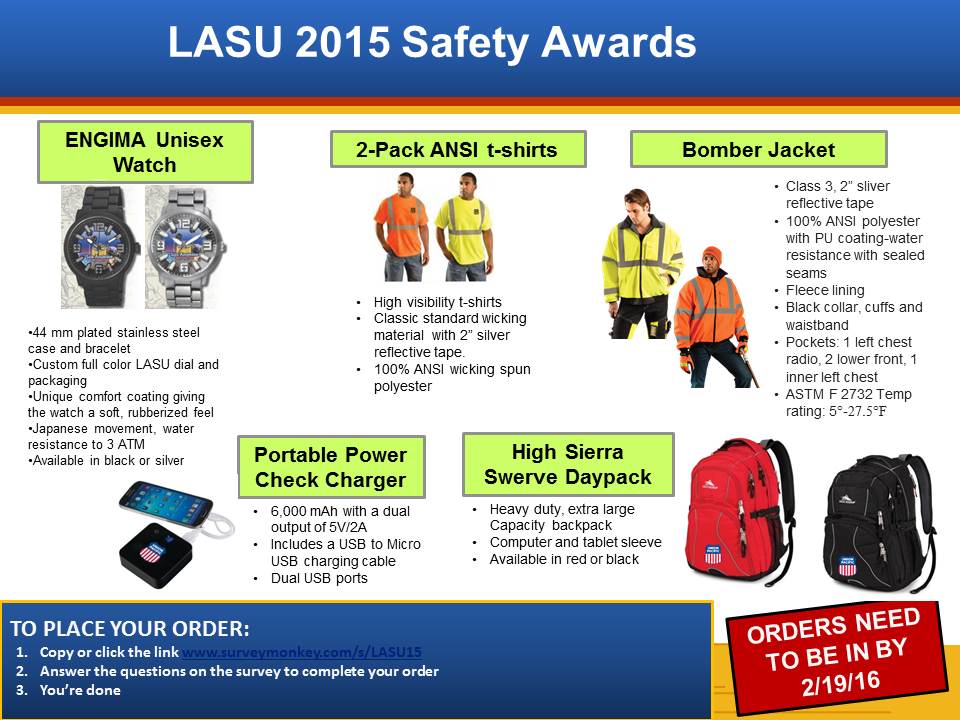
January 1st-December 31st 2015 LASU Safety Award Options
There will be a choice of 5 Safety Award options for January-December 2015. To qualify you must:
1. No injuries
2. No HF derailments where the person was charged as responsible party
3. No decertification
PLEASE HAVE YOUR ORDERS IN NO LATER THAN FEBRUARY 19, 2016. THANK YOU!
 BLET Division 5
You must be logged in to post a comment.